
Transforming STEM Project:
Enhancing Inclusivity for Trans and Non-Binary People in the Faculty of Medicine, Health & Life Sciences, Queen’s University Belfast
The Transforming STEM project explored the experiences of trans and non-binary students and staff within the Faculty of Medicine, Health & Life Sciences (MHLS) at Queen’s University Belfast, with the aim of identifying practical, community-led actions to strengthen inclusion and belonging.
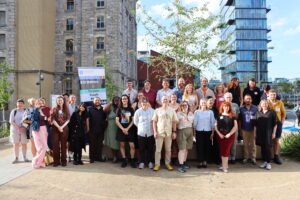
The project delivered two Transforming STEM listening events in February and March 2026. The first was a closed session for trans and non-binary staff and students, enabling participants to set the agenda and speak openly about their experiences. The second brought together trans and non-binary staff and students, allies and wider stakeholders to explore the issues raised and consider how the Faculty could respond. These listening exercises were developed and delivered closely with two partner organisations in Belfast, The Rainbow Project and Trans Resource Centre, whose knowledge and experience were essential in making sure the work was grounded in real community needs.
Both events were very well attended and generated meaningful conversations, with further opportunities for collaboration and potential publications emerging from the discussions. The sessions took place against a backdrop of considerable concern about developments in the UK political environment, with participants describing feelings of uncertainty, upset and erasure. The willingness of students and staff to engage openly was therefore particularly significant.
A key finding was that Queen’s University is perceived by many trans and non-binary participants as a relatively welcoming and supportive environment, particularly when compared with previous educational experiences. Positive practice included straightforward name-change processes, recognition of gender identity irrespective of legal status, strong LGBTQ+ community connections in Belfast, positive examples of inclusive teaching, and good-quality gender-neutral facilities within the Students’ Union.
However, participants identified a significant gap between what exists and what is experienced or visible. The central message emerging from the sessions was that resources and interventions do exist but often they are inconsistent, invisible, or rely on trans people to make them work.
Participants highlighted inconsistent communication of support, limited visibility of policies and networks, inadequate or poorly signposted gender-neutral facilities, experiences of misgendering and deadnaming, and the emotional burden placed on trans and non-binary individuals to educate others or advocate for themselves. Concerns were also raised around representation within the curriculum, trans healthcare education, career progression, clinical environments and access to trusted wellbeing and healthcare services. PhD and clinical students were identified as particularly vulnerable to isolation.
The project has therefore identified a clear set of priorities, including the development of a Queen’s Trans Resource Hub, improved signposting and visibility of existing support, regular trans and non-binary networking opportunities, better access to gender-neutral facilities, embedded rather than optional inclusive education, and stronger institutional visibility and support. Longer-term ambitions include curriculum reform, greater representation and role models, community partnerships, and support for trans-led research and inclusive research practice.
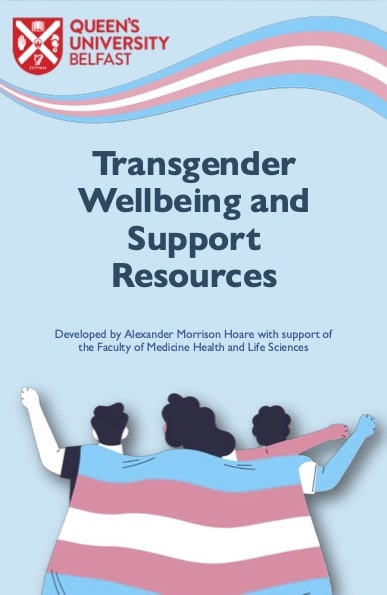
An important outcome of the project is that the work is already extending beyond the original listening sessions. Alex Morrison Hoare, a second-year Medical student, secured funding for an eight-week project to develop practical signposting and resources for trans and non-binary staff, students and allies. This has resulted in the completed booklet Transgender Wellbeing and Support Resources, providing a tangible resource arising directly from the needs identified through the project.
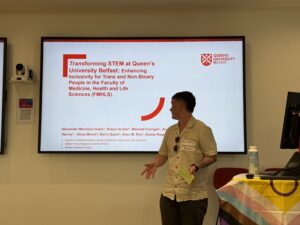
The project has also supported the development of trans and non-binary student leadership and visibility. Alex presented the work at Pride in Research 2026, an all-Ireland symposium celebrating LGBTQ+ researchers and allies, where he received the Best Presentation award, voted for by delegates. His presentation was recognised for its passion, clarity, precision and ability to engage with questions. This represents a significant achievement for a student delivering his first conference presentation and demonstrates the wider potential of the project to build confidence, visibility and leadership among trans and non-binary students.
Overall, Transforming STEM has demonstrated that there is considerable goodwill and a strong foundation for inclusion at Queen’s University Belfast, but that this needs to be translated into consistent, visible and embedded practice. The project has moved the conversation from identifying barriers to developing practical solutions, while creating opportunities for trans and non-binary students and staff to shape those solutions themselves.
The project’s central legacy is a shift in responsibility, where inclusion does not depend on trans and non-binary people having to continually advocate, educate or explain but becomes part of how STEM operates every day.