
Beyond Endocrine Disruption: Exploring Endocrine Life with LGBTQ+ Communities in Teesside
What does it mean to be queer in an industrial environment? And how might the places we inhabit shape what our bodies feel able to do?
In Teesside, these questions have particular significance. In 2013, a local newspaper celebrated declining discharges of endocrine-disrupting chemicals (EDCs) into the River Tees under the headline ‘It’s a man’s world again for our fish.’ The article described how these so-called ‘gender-bending chemicals’ had interfered with hormonal systems, causing male flounder fish to develop female reproductive characteristics. While endocrine disruption raises genuine environmental concerns, the article reflects a broader stigmatising discourse in which environmental contamination is imagined to produce queerness through disrupted sex hormones.
As a queer geographer, I (Jay) wanted to challenge these narratives by working with LGBTQ+ communities in Teesside to explore endocrine and environmental science through their own experiences of place, without reproducing associations between queerness and toxicity. To do this, I focused less on EDCs themselves and more on how environments shape what queer people feel and are able to do, particularly through hormonally mediated capacities for rest, recovery, stress regulation, social connection, and self-expression.
With support from Pride in Stem, I organised two creative workshops in Teesside for LGBTQ+ participants to creatively explore their relationships with local environments. The funding covered venue hire, collaging materials, travel, refreshments, and participant support.
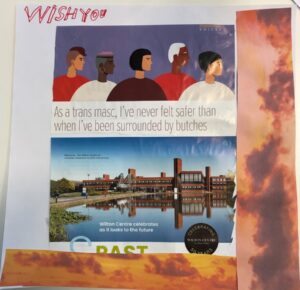
Collage 1: A collage exploring relationships between queer love, identity, and industrial power in Teesside
Exploring environments of queer possibility
In the first workshop, 15 participants created collages environments where they felt most able to express their queer identities. Their creations explored safety, pride, community, and belonging across urban and natural spaces.
While participants readily expressed how environments supported queer identity and belonging, connections with industrial conditions and bodily experiences were less explicit. Even where industrial landscapes or emissions appeared, their social or symbolic significance took precedence over potential bodily effects. This raised a question: how do queer people understand the effects of environments on their bodies, wellbeing, and capacities for self-expression?
The second workshop explored this question through participatory mapping, with 11 participants mapping familiar places and routes to explore how different environments shaped their bodily feelings and capacities.
Participants described how different environments, including industrial landscapes, could support feelings of comfort and confidence in expressing themselves. One participant described moving through industrial areas as making them feel like a ‘smoggie queen,’ reclaiming a term often associated with industrial pollution as an expression of queer pride and belonging.
For me, this revealed how environments often implicated in bodily harm could also sustain queer wellbeing and identity. By queering landscapes historically associated with industrial masculinity, participants showed how these places could support queer bodily capacities rather than simply constraining them, complicating narratives that reduce queer relationships with industrial environments to contamination and disruption.
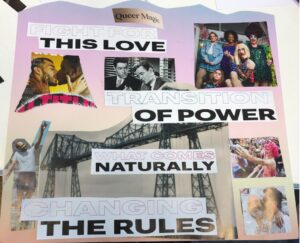
College 2: A collage exploring how queer identity is shaped through relationships with the industrial landscape of the Wilton complex in Teesside.
What the project made possible
Beyond the research findings, the workshops created a supportive space for LGBTQ+ participants to explore how their environments shape their wellbeing.
It was particularly rewarding to hear participants who didn’t consider themselves creative describe how the activities helped them explore their relationships with environments in ways that ‘just made sense.’ One reflected that they hadn’t previously considered how much their environment affected their wellbeing and ability to express themselves as a queer person.
The research has also contributed to a co-authored article on Trans Geographies of Creativity, recently submitted to Gender, Place and Culture. Pride in STEM’s support made these outcomes possible, demonstrating the value of using concepts from endocrine and environmental science to inform creative community explorations of how environments shape bodies and queer wellbeing.
Collages created by participants during the Pride in STEM supported workshops. All artwork is shared with participants’ written informed consent, in accordance with the project’s research ethics approval.