
Who Gets Counted in Cancer Research? LGBTQIA+ Experiences and Perspectives on Health Data Research in the UK
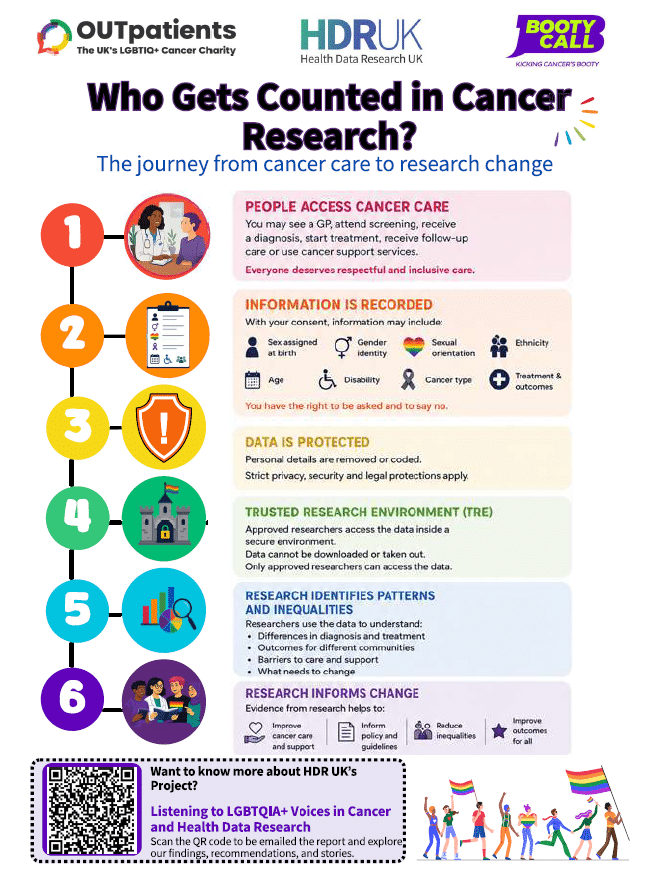
We identified a significant gap in how LGBTQIA+ communities are represented in health data and cancer research. To better understand these inequalities, we designed a public consultation in partnership with OUTpatients, an LGBTQIA+ cancer charity.
Together, we delivered two workshops with LGBTQIA+ people with lived experience of cancer, alongside two surveys. One survey gathered perspectives from healthcare professionals involved in collecting sexual orientation and gender identity (SOGI) data throughout the cancer journey, including nurses, oncologists and GPs. The second explored LGBTQIA+ people’s experiences of SOGI data collection, their priorities for cancer research and their perspectives on health data research in the UK.
The grant enabled us to work with OUTpatients as a specialist consultancy partner, whose expertise was invaluable in shaping inclusive language, co-facilitating workshops and recruiting participants. Across our activities, we heard from over 100 members of the public.
What did we learn?
We gathered many, MANY valuable insights, which we hope to publish in a dedicated Patient and Public Involvement and Engagement (PPIE) report.
One of our most important findings was that SOGI data collection is largely inconsistent, something reported by both healthcare professionals and LGBTQIA+ participants. Additionally, many participants described not disclosing their sexual orientation or gender identity for fear of discriminatory or prejudiced treatment during their cancer journey.
These findings are particularly important because researchers rely on health data to understand inequalities in disease screening, diagnosis, treatment and outcomes. SOGI data can help identify disparities in cancer care and ensure research is representative of the communities it aims to serve. However, how this information is collected, explained, protected and used matters enormously.
Our conversations explored questions such as:
- How does trust influence people disclosing SOGI information?
- What would make people feel more comfortable sharing information about their identity?
- How would LGBTQIA+ people like to hear about advances in cancer research, screening and treatment relevant to their communities?
- Where do the priorities of LGBTQIA+ people and healthcare professionals align for future health data research, and where do they differ?
These discussions reinforced the importance of involving communities not just as research participants, but as partners in shaping research questions, approaches and decisions.

From conversations to meaningful change
One of the highlights of this project has been bringing together different perspectives and beginning to translate people’s experiences into practical recommendations for researchers and healthcare professionals. We’ve also started conversations with researchers interested in taking this work further and improving approaches to SOGI data collection.
We’ve been exploring creative ways to share our findings beyond traditional academic audiences, including community-facing activities delivered in partnership with Bootycall CIC, an LGBTQIA+ community interest company known for its wonderfully camp, queer-coded events. Think lots of glitter, a DJ in a colon, and information about health data research displayed in the loos and at conversations about health data and this work at Pride events!
These activities have allowed us to bring conversations about cancer research and health data into spaces where LGBTQIA+ communities already gather, making research more approachable, relevant and accessible.
For us, this is an important part of meaningful public involvement. Research shouldn’t end when the survey closes or the focus group finishes. People who contribute their experiences should be able to see how their voices inform what happens next.
Ultimately, this project is about more than improving data collection. It’s about ensuring LGBTQIA+ communities are counted, represented and meaningfully involved in shaping the future of cancer research. If you have any questions about this project please contact: ali.timmons@hdruk.ac.uk
For more information on our programme please see what Big Data for Complex Disease is up to: https://www.hdruk.ac.uk/research/research-driver-programmes/big-data-for-complex-disease/
If you’d like to follow us on LinkedIn to see what other Public Involvement and Engagement we are doing: https://www.linkedin.com/company/hdruk/posts/?feedView=all
If you’d like to see what the project Lead, Ali Timmons, is doing, connect with her on LinkedIn: https://www.linkedin.com/in/ali-timmons-msc-486955104/